Quick, quick, slow…

I’ve been teaching a lot recently, followed up by a week’s residency at a museum. All this has given me more exposure than usual to lots of people with their thoughts and opinions about printmaking. This of course coincided with a period when Radio Four actually seemed to be cheering up a bit with some more upbeat programming. (At least that is how it sounded as I twiddled the volume up and down in time to the arrival of visitors. Doubtless now I am back in the studio it will be a return to job loss, terminal illness and general all round middle class angst.)

This has resulted in the interesting and at times frustrating fact that on the one hand I have students who are excruciatingly hard on themselves for not managing to produce a perfectly aligned and sensitive Japanese woodblock in the space of a few hours, while on the other I have people telling me that what I am doing is akin to potato printing they did at school.

A lovey first time attempt by one of my recent students - one to be proud I think.

A lovey first time attempt by one of my recent students – one to be proud of I think.

In fact both attitudes are a symptom of this present fiction that arts and crafts are achievable and achievable fairly fast. I know that there is a great deal of TV time given over to darning socks with retro wool and hand baking your own sofa cushions, but these programmes either insist you do it within the hour or face elimination, or worse, they simply gloss from thought to result with an airy ‘ooh I never thought taxidermy would be so easy!’…

Fact is that being good takes time and practice. Knowing what to do is one thing, doing it fluently is quite another. I know how to plaster a ceiling, but every time I lie in my bath I can see that an apprenticeship would have been a good idea. One of the best things about my residency in Japan was to learn that time spent in practice was time spent well and that hard won expertise was to be respected and honoured. It’s the only time I have had my job description win more respect for me than less from the man in the street.

raising fine detail by clearing away most of the wood, this takes time to do well and accurately

raising fine detail by clearing away most of the wood, this takes time to do well and accurately

So please students, stop beating yourself up: most of you do better than I did in the same space of time, much better and, if you apply yourself as I do, then the floating world of Japanese printmaking is your oyster. To the potato printers from school, you are spot on: relief printing is the same process and, like you, I did that at school too. I also learned to play tennis, but sadly I’m a long way off the professional circuit…

Posted in Uncategorized | 5 Comments

The Postman Always Rings Twice (and sometimes lots more often)

At the moment there is somebody out there in internet land who is convinced that I ache to play bingo. Several times a day I am showered with mail encouraging me to rush some site, spend my money and waste my time. It doesn’t matter how many times I unsubscribe and mark the mail as spam, Mr Bingo keeps on trying. I wouldn’t mind, but the thought that I now belong to a demographic of bingo playing types (no offence, but in my mind that equates to drinking port and lemon and having a best hat) is rather demoralising. Junk mail, how I hate it.

However, it must also be said that I am keen to mail people myself. An important part of my work is keeping a mailing list. I like it: it’s like having an online pet. It grows and I am delighted, it shrinks and I worry. I am nerdy in checking my analytics; graphs that are all about me are much, much more fun than anything I learned in CSE maths (yup, too mathematically challenged to sit an ‘O’ Level, though I did get a grade one and that, I believe, came the same thing. Best of all I was taught by the teacher who survived being shot with a rifle while waiting at a bus stop – most kudos in the maths department obviously…)

I do try and avoid Mr Bingo’s lovebombing technique. These days we all have to wait for people to want to subscribe and nothing will put people off faster than asking them to sign up for emails. Needy, just like in dating, is not the way forward. I prefer the insouciance of the carefully placed clip board, the casual reference to my mailings: ‘What? You’d like to sign up? Really? Well please do give me your address’. It’s an option on my web site, but you do have to actually sign up rather than be tricked into it by Yoda style grammar. I never combine my visitor’s book with mailing list form. People should be entitled to tell me that they like/love/hate my work without feeling I may send love/hate mail in return.

The mails themselves I try to make fun, lots of pictures, useful links, a bit about the ongoing story of my work and, most important of all, I only send them when I have something to say. And that doesn’t include saying the same thing again and again in the hope that the recipient will crack and, in my case, develop a keen need to shout ‘house!’ at my laptop.

Posted in Uncategorized | 2 Comments

The Dating Game

Recently I stepped away from having a paper diary and into the cloud world of an electronic diary. The idea of relying on a cloud to keep me up to date with the daily dance of students, galleries, teaching venues, delivery dates (not to forget cat inoculations, the dentist and birthdays) is not terribly confidence inspiring. However, it seems to work and my also-new android phone trills and buzzes with reminders and updates, telling me that I am so terribly important now.

I know artists traditionally have the reputation of being above such mundane tasks, but the fact is that, however fabulous the work, nobody loves an artist who is late or forgets to sign contracts, delivers work on the wrong day or, my personal nightmare, doesn’t turn up to teach their class. There are precious few of us famous enough to get away with this sort of flaky behaviour. It’s my experience that an artist’s reputation is as fragile as a Hardy heroine’s: once the word gets out that you are trouble, people will move on. The plus side to this is that a reputation for being on time, on budget, well prepared and generally efficient will result in work, bookings and happy galleries.

This was brought home to me today when I finally compared my Cumulonimbus’s worth of teaching and exhibiting dates with the events and teaching pages on my web site – disaster! I’ve slipped out of sync and had to spend several hours updating. That opens up the can of worms that is web site maintenance (another time I think, I’m stressed enough as it is). I guess I will have to add yet another task to the diary to update regularly so this doesn’t happen.

I don’t suppose it matters how you keep a diary; I’ve had all sorts in my time from lockable ones (two days worth of serious teenage angst and then forgotten), an eighties filofax (too big) through Moleskines (so hip) to the cloudy one. The point is to pay attention to it. I am very late to the electronic diary, but now I have it I find it has two great advantages: it chirrups until I pay attention plus I can book courses in a year or two ahead without scrawling hopefully in the back of the current year. The only thing I miss is the annual choosing of the colour…

Posted in Uncategorized | Tagged , , , | Leave a comment

Touching Up

The subject of touching up is always a bit controversial even when, as here, I am referring to prints rather than people. It is something my students tend to discuss between themselves in whispers as though expecting me to descend on them with a cane if I were to catch them at it. Far from it: I do it myself.

There are plenty of purists out there who apply rules to the making of art and craft. Some of those are quite rightly maintaining guilds and official standards – botanical painting springs to mind. Others just want to keep things ‘proper’. The latter always make me want to be as improper as possible. I had a meltdown in a marquee once when some ladies told me that I ‘couldn’t’ spin wool the way I had learned in a croft on Islay (and how proper an apprenticeship is that?) because it wasn’t the way they did it. I may be doing it wrong, but my jumpers seem to work OK…

Japanese woodblock with some hand colouring

Japanese woodblock with some hand colouring

In the small world of my studio, I believe that as long as whatever you do doesn’t affect the archival integrity of the work, then it’s all fair game. To that end I blot off marks, correct coverage by painting with the pad of my fingertips, touch up with brushes (sadly this latter is almost impossible with Japanese woodblock and, interestingly, vitreous enamel. Both being too sensitive to hide that sort of correction) and generally do what I have to if I think it will improve the result. I also mend woodblocks with filler and glue when I get the chance. Lino is not so cooperative to repair, making it swings and roundabouts in terms of touching up prints.
I also hand paint certain parts of prints sometimes and this picture is an example in point. I wanted some of the leaves to have gold on them so I have dropped it in with a brush. I’m OK with that, though purists would argue that a Japanese woodblock should only be printed. Actually, I think the Japanese are great pragmatists: they printed every detail during the Edo period because they were mass printing for a client, not working on personal limited editions. I would hazard a guess they would touch in colour if it was the practical answer.

The conclusion I’m aiming at is that I never feel bad about touching up and corrections and I strongly advise students to make this a practical part of their knowledge. Maybe when I get on in years I will end up in a tent telling people that they are doing it all wrong, but I don’t think that’s likely. I’ll probably still be in my studio breaking the rules myself…

Posted in Uncategorized | Leave a comment

Behind the scenes

Like most people, I do try to present a fairly polished front to the world when it comes to my work. Certainly I do my best to be organised and efficient at the admin end of the business (investing in a desk and a filing cabinet has been a revelation and I am pathetically thrilled by having a basket on my desk with stapler and sellotape to hand. Scissors still elude me despite bulk buying, but we can’t ask for everything…)

The upshot of all this is that I tend to only show the good bits of my work: the neat little sketches with potential, the studio shots where I look in control and am not squinting at the camera in a confused leer and, most of all, finished prints. For a change I thought I would show you some heart ache. Things don’t always go well and this print has been a really good example of what can go wrong. Inevitably this was the last print in the series of fourteen due for my client with a deadline looming and almost as inevitably I developed a head cold featuring a dangerously drippy nose at the same time.

working proof showing how things shouldn't look

working proof showing how things shouldn’t look

Japanese woodblock relies on a series of registration slots called Kento. These slots are cut by chisel onto the wood along with the block for printing and are crucial to lining up all the layers of the print into a full coloured picture. They act as a guide and the printing paper fits into them and is held in place to take the impression. Get any of the Kento slots a couple of mm out and the picture will be wonky. The print here has 18 different Kento slots (some of the blocks share a Kento, there are roughly 45 to 50 different woodblocks for this picture) and somewhere along the line I was out of sync.

Trouble is that it isn’t until I start printing that the problem becomes clear and even then it is seldom obvious just which kento is the problem and with several blocks sharing a kento, it could be just one of them that is out of line. The paper doesn’t make things easy either: it must stay damp, consistently the same damp, or it changes dimension. The bigger the print, the bigger the distortion. This print is 120cm wide and the paper can change by as much as 4mm as it dries. It’s easy to control if all goes to plan, but have a head scratching crisis of alignment and the paper is against me, drying out as I try to see the break in the chain of Kentos and adding to the confusion.
In the end I did manage to get a finished print without the benefit any drips from my leaking nose, but it was a nightmare.

DSC_0234I would love you all to think that I have everything under control and things always go to plan, but it’s not the case. I do get caught out, as I have here, and I am far from perfect. It’s just that I tend not to talk about it much!

Posted in Uncategorized | Tagged , , , , , , | 4 Comments

But is it Art?

20130205_144225

Is this art, craft or something else?

I’ve just accepted a booking to give a talk about my work as a printmaker. The reply was that the group were looking forward to it ‘although some of the members will need to be persuaded that printmaking is art’. I was a bit floored by this. Art seems sometimes to be more class ridden than a day out at Ascot. I’m used, as a printmaker, to being considered fairly low on the scale. Indeed, as a linocut printer, I am sometimes given the impression that I’m a grubby tag-along at best. The idea that what I do for a living isn’t even art was a novelty though.

I’m my father’s daughter. As a self made man with a desperately hard childhood he would say ‘Who gives a damn what you call it as long as they get their wallets out’. I’m not going to lose any sleep: my work sells, my teaching is in demand and I’m confident in my work. However I wonder if the good members of the group think perhaps printing is more ‘craft’?

I’d be the first to agree that there is a strong element of craftsmanship in printmaking and craft skills are something I am seriously proud to have: craft, like printmaking, tends to be dismissed. Craft has suffered from being used as a catch-all name for the peddling of tat at what used to be called ‘Bring and Buy’ and now are inevitably ‘Craft Shows’. So printmakers are confused with the button pressing of the modern computer printer and mindless mass reproduction. I now have to explain that my work is entirely hand cut and hand pulled by me which generates true astonishment at times.

I’d like to reclaim both art and craft for printmaking in the true sense of the words. The craft is in the process. It is a very highly skilled job to be a good printmaker and it requires years of practice learning the craft. The process skills can be taught to anyone given the time and I’m confident I could produce a craftsman from the man in the street (should he wish to be kidnapped and kept in a studio for a very long time), but that wouldn’t make him an artist. The art bit is knowing what to do with those skills when you have them.

I’m not sure that this thinking would change much in the hierarchy of the art world where conceptual fine art seems to be top of the heap at the moment, but at least I have my thoughts in order for the talk I have to give…

Posted in Uncategorized | 4 Comments

Sale of the Century

I’m always a bit worried by cultural stereotypes, trying to define people by nation or class always seems a bit ‘them and us’ to me. However, if there was ever a truth about me it’s that I am hopelessly English middle class when it comes to talking about money. I am overcoming this by blog therapy as those of you who read my blogs will have seen. I can be very brave behind a keyboard. This time it’s about discounts and cutting prices.

I do occasionally get asked to cut my prices by potential clients and this is an interesting one. Thanks to my absolute Englishness about haggling, I get all squirmy. Well, my toes hidden in shoes do: never, ever squirm visibly in front of the client. Below are my thoughts; not just or for those of us who also a) listen, however intermittently, to the Archers and b) like marmite (no really, knife from the jar, like it), but for all who struggle with being upfront about money with clients.

My best advice here is to think long and hard about this before you get into the situation and make your decisions in advance. Bit like writing ‘I do not want a rubbish time share apartment in Marbella’ on your hand in indelible ink before going to collect your amazing free gift, this gives you rules to follow which will save you getting flustered on top of the toe squirming.

My decision is to not give discounts on the whole. My work is priced very fairly for the labour and skill involved and it is priced the same wherever it sells, so that the client never has to worry they are losing out. I would also point out that for every one person who wants ‘a deal’ there are lots of people, including those who collect, who never have asked for or expected a discount. If those lovely people don’t get a deal, why should a stranger get a better price? What I will do, and to me this is one of the most pleasurable things about being an artist, is to occasionally give away a print. This takes people by surprise and I get to choose who gets one and what sort of print they get.

Rules, of course, are made to be broken, but I try never to be hassled into breaking mine. I will give a discount of 10% very occasionally for someone buying more than one expensive print if I think there is good reason, taking the loss on the frame and not the print. I also agree to allow galleries a bit of ‘wiggle’ room as they have to be a judge of when it is prudent to discount work slightly, though not across a sale of work by several artists where the only winner is the gallery.

My final comment is that the sort of people who hassle you for discounts on the ‘oh but we love your work and will buy lots more’ card almost never do. If they are an exception to this truth, regrettably there’s another disagreeable truth about them: they will always want a ‘deal’ on the basis that they are now your ‘special’ clients.

This is only my take on discounts. You may embrace a whole other system. The big point here is that you make the rules about your work and you’re allowed to do that. It may mean ignoring every fibre in your cultural soul, but firmness about pricing is best.

(Remember you can always have a nice hot cup of tea to soothe your nerves after they’ve gone)

Posted in Uncategorized | Tagged , , , , , , | 3 Comments

Lucky, lucky, lucky

This blog is going to be a tricky one because I do hate to sound like someone who is having her cake and eating it, especially since to have cake is to eat cake as far as I am concerned, especially in cold weather.

I recently had a conversation which ran along the lines, familiar I imagine to most artists, makers, writers, poets, craftspeople etc, of ‘Oh so you are an artist?’ (last word pronounced in the sort voice people use for mythical creatures – though more unicorn than troll I’m pleased to say). ‘You are so lucky doing that and not going out to work’.

This is it is a conversation that crops up very regularly, especially when I open my studio to people. Let me say that yes, I am very lucky to work from home: where else can I work in pyjamas with the cat on my knee and not worry about using a stanley knife straight onto the work surface? That I agree is a privilege, but isn’t not exclusive to artists and indeed, when I was a credit controller wheedling photography professionals into paying their bills (not a huge success, I made too many friends) I did it from my spare room pretending to be wearing a suit while sitting, feet up, on the bed. Anyone who works from home is lucky, but also, if they do actually do the work, has drive and self discipline.

Then there’s the sting in the tale: is being an artist work? I think it is. It is work I love, but I don’t love it any more than the shopkeeper passionate about his news agents or the accountant fiercely happy balancing books. Truth to tell, so much of my work is admin and teaching (if I tack ‘teacher’ to ‘artist’ it often solves the problem because teaching is a real job, though conversely many creatives see it as a major cop out), meetings, visits etc that it begins to look pretty much like standard work. The difference is that the whole enterprise balances on me managing to put colour and line down on surfaces in a way that people will not just pay for, but pay enough to make it worth my while.

So yes, I am lucky to be working at a job I love in a place where slippers are dress code, but that sort of luck applies to many people, not just us artists. In answer to the statement I quoted the famous ‘The harder I work, the luckier I get’ which surely applies to everyone?

Posted in Uncategorized | Tagged , , , , , , | 6 Comments

Anti-Wrinkle Treatment

Paper has a hard time in my hands as a printmaker. I put it through all sorts of stresses and strains on the way to making a print and still expect it to finish up as a pristine, flat sheet of loveliness at the end, though hopefully with a layer or two of colour on top.

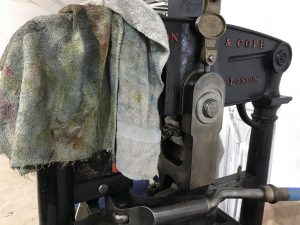
Oil based lino prints aren’t a problem. I’ve been doing them a long time: I use Zerkal paper (like most of the printers I know) and it works a treat, staying nicely flat under the pressure of my Albion press. The clever bit for me here is keeping my filthy hands off the edges of the print.

The Japanese printing I do is a whole different story: this is a watercolour process, the paper is damp and I am constantly stretching the paper with hand rubbing in different places. The Fabriano I use, while very good tempered about taking the paint, can be very hard to dry flat, especially if the print is large.

I have very recently, after lots of stacking and balancing acts with everything from those big cookery books, the sort with just the one great recipe, to old bricks, discovered a way to resolve the problem. I now use two large sheets of birch carpenter’s ply held absolutely tight together with butterfly clamps. Butterfly clamps are a builder’s equivalent of a peg, but massively stronger and much larger. I bought mine off a puzzled man in my local market at £1.50 each. They have rubber over the gripping mechanism which protects the ply should you later want to turn it into a woodcut. Buy plenty: the more you clamp, the better.

I put my damp prints straight onto the clean ply and put another sheet over the top (this is 5mm thick ply, it’s probably best to have it fairly sturdy) and simply clamp all the way around with my butterfly clamps. It takes about two days or so to work and the prints are beautifully flat at the end. The ply absorbs the moisture, then dries out and off you go again, though you must keep it clean. Keeping anything clean for me is a major challenge which is why I go on about it so much.

There is another very occasional problem and it’s pretty much out of my control: pictures getting damp in frames and then coming back from wherever they have been shown cockled. These wrinkly prints can be both linocuts and woodblocks. With these, after stomping about a bit in temper, I remove from their frames and make up a sandwich of slightly damp blotting paper. I put the prints, oil based lino included, into the blotting paper parcel and allow the prints to get damp for about 4 hours or so. At this stage they become alarmingly wrinkly and look terrible. They then go into the ply and I dry them as before. The result is again a lovely flat print.

I can’t promise that this will work well for every sort of print, you’ll have to try it for yourself, but it certainly works for me…

Posted in Uncategorized | Tagged , , , , , , | 1 Comment

Colour coded

This weekend I spent printing one of my fourteen giant watercolour woodblocks for the Health Centre on the Isle of Wight. It was never going to be easy: Japanese watercolour woodblock is really designed for perhaps A3 or less, not for over a metre wide. However, the medium does, provided your nerves are steady and your arms long, allow for printing on any scale as there is no press to limit size.

West Cowes, Isle of Wight

West Cowes, Isle of Wight

The main thing, in my opinion, is to get the colours right. No good having a foreground dislocated from the background or lose the sense of distance in a squash of mismatched pigment. I’m stuck with doing this in my head as I go along because I find that the more I plan, the more the life of the print seeps away. To this end I have many, many little glass tea light holders (thank you IKEA. And while I mention the Norse god of home solutions, you can buy sheets of heavy glass with ground edges, perfect for mixing inks, for a song at IKEA just now. Just look for ‘Malm glass top’). The holders are filled with what my lovely Irish father-in-law describes as ‘Laura’s designer sh*t colours’. They get gradually more and more mixed up as I go and result in what I hope is a subtle print of correctly balanced colours. Not so easy this time with dozens of separate little abstract shapes – is it a bird, is it a plane? No it’s the back of a warehouse… You get my drift.

I do test colour and the way to do this with a Japanese print is to take a test sheet of paper (you will of course keep all the trimmings from cutting down your papers to size. Also good for posh shopping lists and guaranteed to impress when you go to pick up your sushi ingredients. Believe me, the Japanese will notice). Put a blob of mixed watercolour on one side of the paper. Take your finger and smear the blob across the paper. It is the smear, not the blob which gives the true result. You also end up with a neat reference sheet which, if you are a better person than me, you could make colour mix notes on as well.

There is a partner to the print here of West Cowes. No prizes for guessing that’ll be East Cowes and for that I have to echo the colours, though not in the matching handbag to shoes way. That would be too obvious. The trick will be to get the pictures to relate, not match. The good news is that there are fewer warehouses on the East Cowes side…

Posted in Uncategorized | Tagged , , , , , , | 3 Comments